

Overview
An EBU delegation composed of Jakob Rosin, EBU Board Member and Chair of the Accessibility Working Group, and Valérie Bertrand-Vivancos, Membership Officer, visited Iceland on 1-2 October 2026. The visit combined participation in the national accessibility conference WAD Iceland Onboard - From Requirements to Reality and meetings with representatives of the Icelandic Association of the Visually Impaired (Blindrafélagið - BIAVI) and the National Institute for the Blind.
The objective of the visit was to strengthen relations with Icelandic partners, exchange experiences on accessibility policy and implementation, and gain a better understanding of services and advocacy structures supporting blind and partially sighted people in Iceland.
WAD Iceland Conference
The first day was dedicated to the IAAP Nordic and ÖBÍ Accessibility event celebrating the incorporation of the Web Accessibility Directive (WAD) into Icelandic legislation. The conference brought together accessibility professionals, regulators, policymakers, academics, industry representatives and persons with disabilities to discuss how Iceland can translate legal obligations into meaningful accessible digital services. It was notably facilitated by Rósa María Hjorvar, Blindrafélagið - BIAVI board member and digital accessibility expert at ÖBÍ.
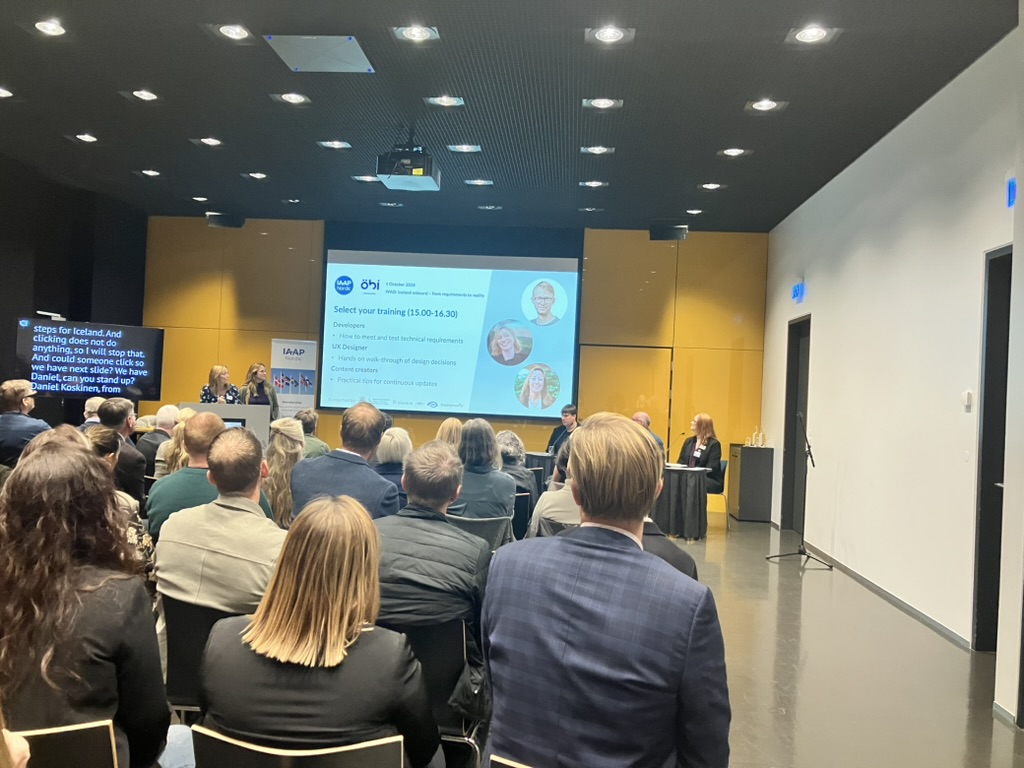
Audience and screens at the “WAD Iceland Onboard - From Requirements to Reality” conference
A recurring message throughout the conference was that legislation alone is insufficient. Effective accessibility requires governance, procurement practices, training, monitoring, enforcement and continuous engagement with users with disabilities. Speakers highlighted lessons learned across Europe, emphasising that accessibility must be embedded into organisational culture and digital transformation efforts rather than treated as a compliance exercise.
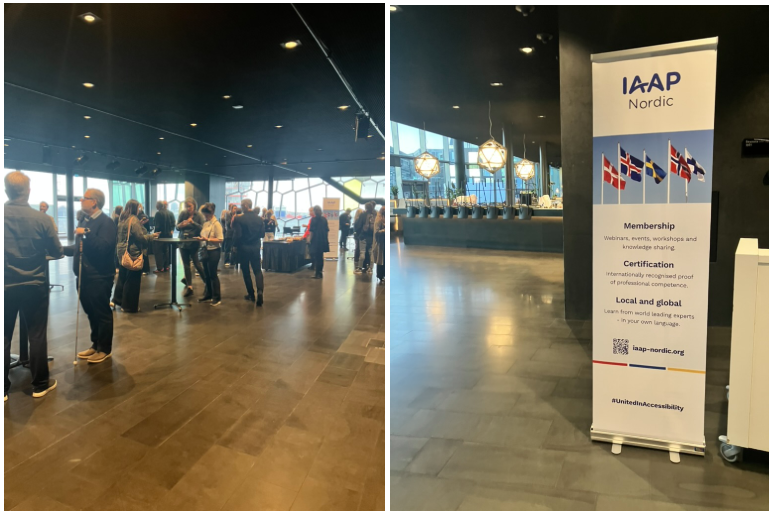
WAD Conference Break out session and IAAP banner at in the Hall of the Harpa Building
Participants stressed that people with disabilities should be involved throughout the design, testing and evaluation of services. The conference also cautioned against relying solely on accessibility overlays instead of addressing accessibility requirements at source.
Jakob Rosin contributed to a panel discussion presenting experiences from EU Member States, sharing good practices and common implementation challenges that may help Iceland accelerate progress and avoid pitfalls encountered elsewhere.
Photo caption: A panel session at the WAD conference, with Jacob Rosin and other guests representing EU member states
The day concluded with a networking dinner hosted by ÖBÍ, the Icelandic Disability Alliance, at the Human Rights House in Reykjavík, hosted by ÖBÍ Executive Director, Eva Thengilsdottir. The event provided valuable opportunities to engage with disability leaders and representatives from a wide range of Icelandic civil society organisations.
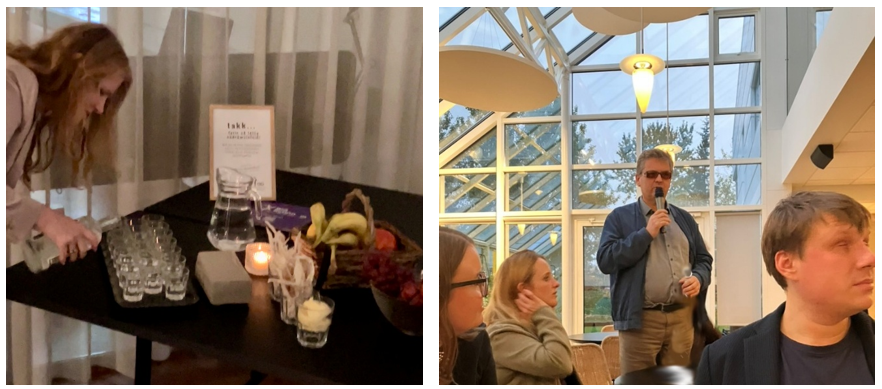
ÖBÍ, Director, Eva Thengilsdottir preparing traditional fish snack, and speech by BIAVI President Sigthor U. Hallfreðsson with guests at the Human Rights House
Visit to BIAVI and the National Institute
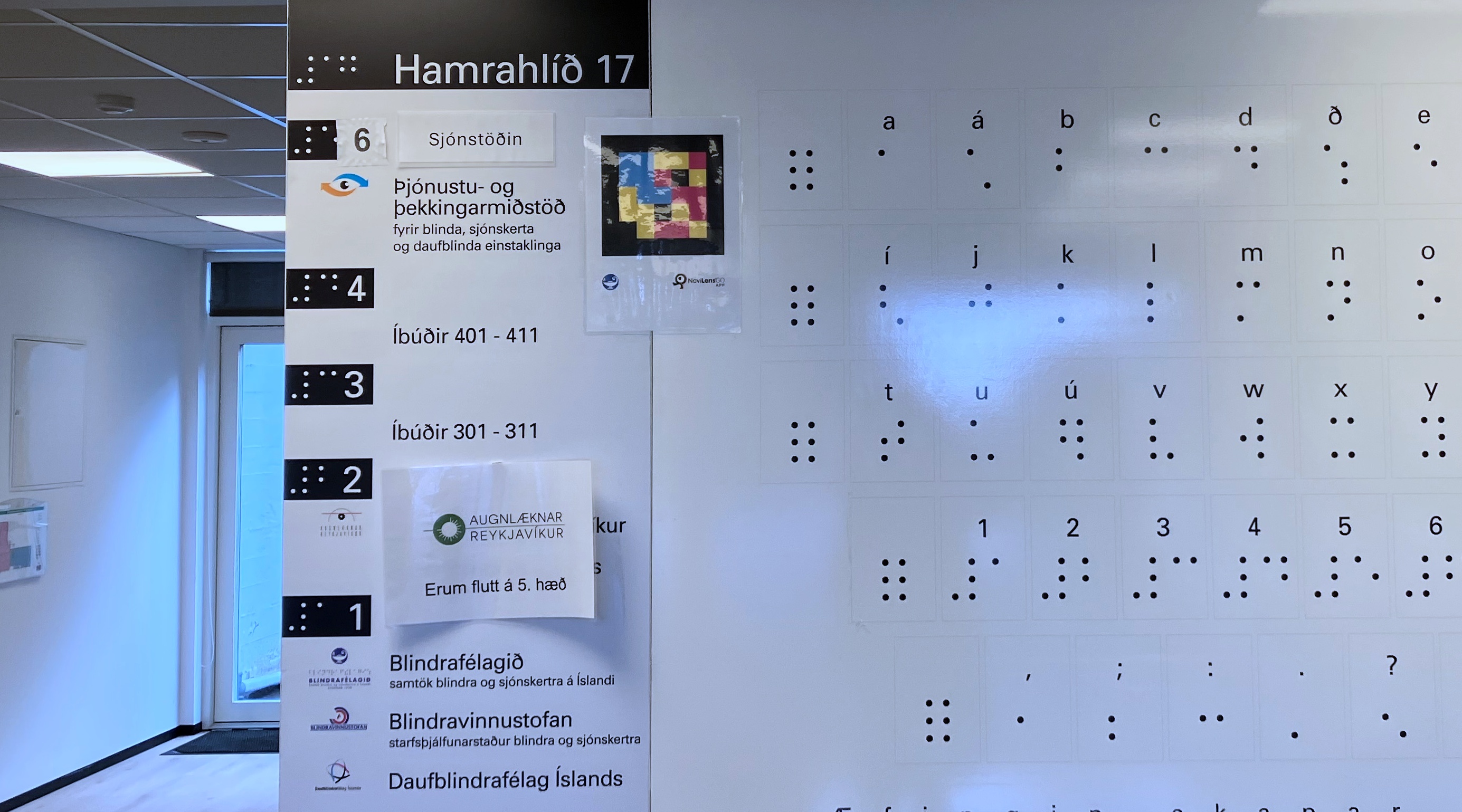
The Icelandic Braille alphabet and building signs in the lobby of the BIAVI building
The second day was devoted to meetings with BIAVI leadership and staff, including President Sigthor U. Hallfreðsson, Communications Manager Mónika Elísabet Kjartansdóttir, Managing Director Kristín Waage, Technology Consultant Baldur Snær Sigurðsson and other members of the team.
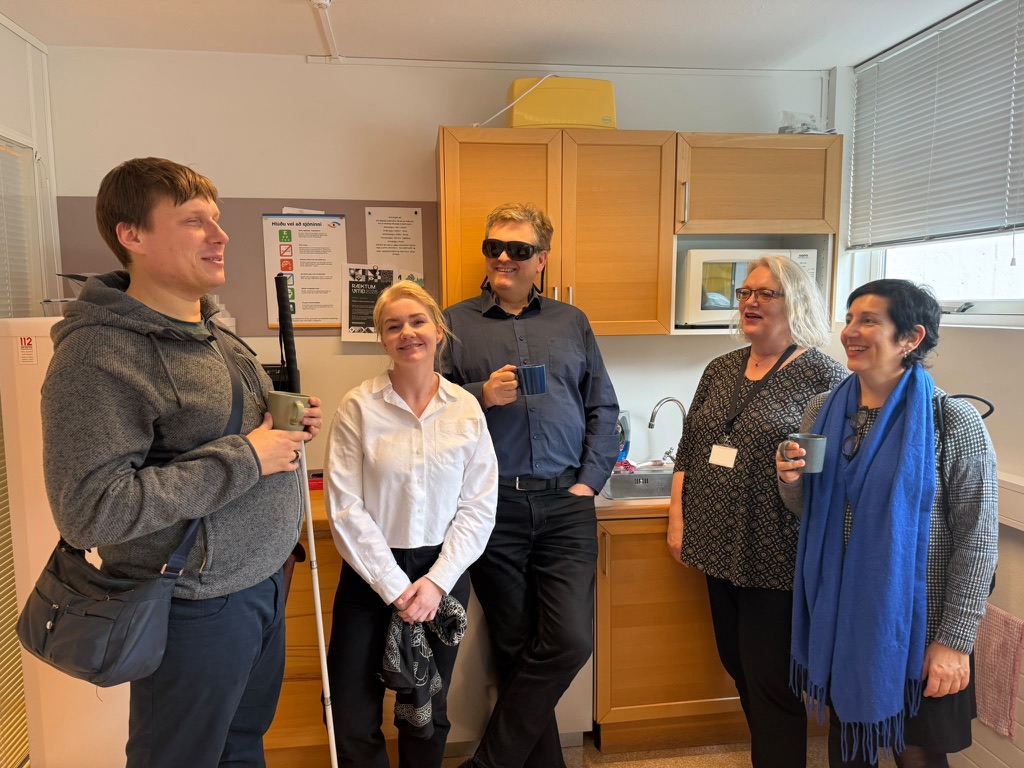
A friendly discussion with members of the EBU delegation an BIAVI staff in their office dining area (Photo Maarja Rosin)
Founded in 1939, BIAVI is Iceland's main non-profit organisation representing blind and partially sighted people. The association currently counts approximately 800 active members and combines advocacy, social support, fundraising and service provision. The organisation owns its premises, derives most of its income from fundraising activities and maintains strong engagement with Nordic, European and global blindness organisations, including EBU and WBU.
The delegation was particularly impressed by the breadth of services available to members. These include counselling, travel assistance arrangements with municipalities, guide dog services, accessible housing opportunities, telephone information services, Icelandic text-to-speech voices, peer support programmes, youth activities, social clubs and a range of grant funds supporting education and independence.
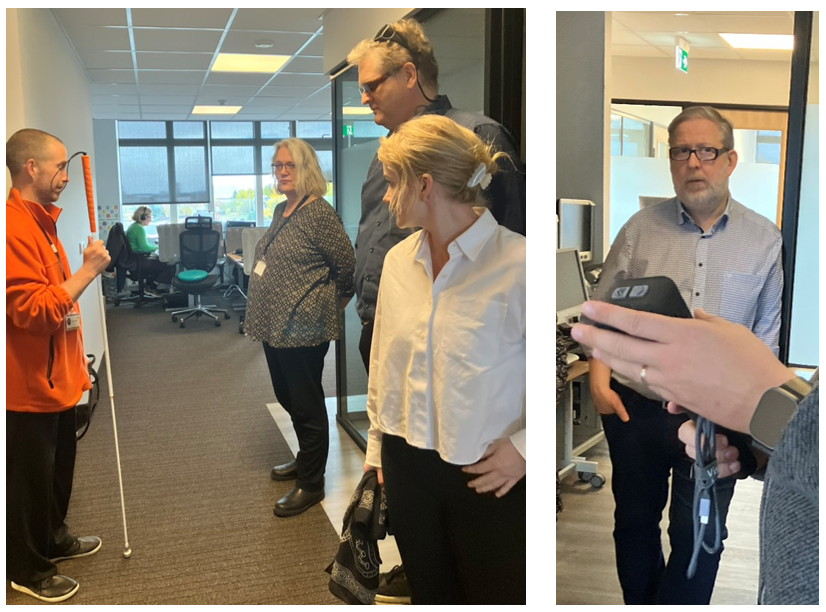
BIAVI staff meeting colleagues during visit at the Blind Institute
A detailed discussion was also held with representatives of the National Institute for the Blind, Visually Impaired and Deafblind, including its Director, Elfa Svanhildur Hermannsdóttir, and staff members Helena María Agnarsdóttir, Assistive Technology Advisor, and Þorkell Steindal, Wellness and Technology Representative. The Institute has operated in its current form since 2008 and has been housed in the BIAVI building since its establishment. Following the addition of a sixth floor to the building in 2023-2024, the Institute relocated to these newly expanded premises in 2024. As a government-funded organisation, it delivers multidisciplinary services nationwide, including assistive technology assessments, mobility training, visual rehabilitation, counselling, educational support, psychology and social services. Importantly, assistive technology is provided following assessment and is available free of charge to eligible users.
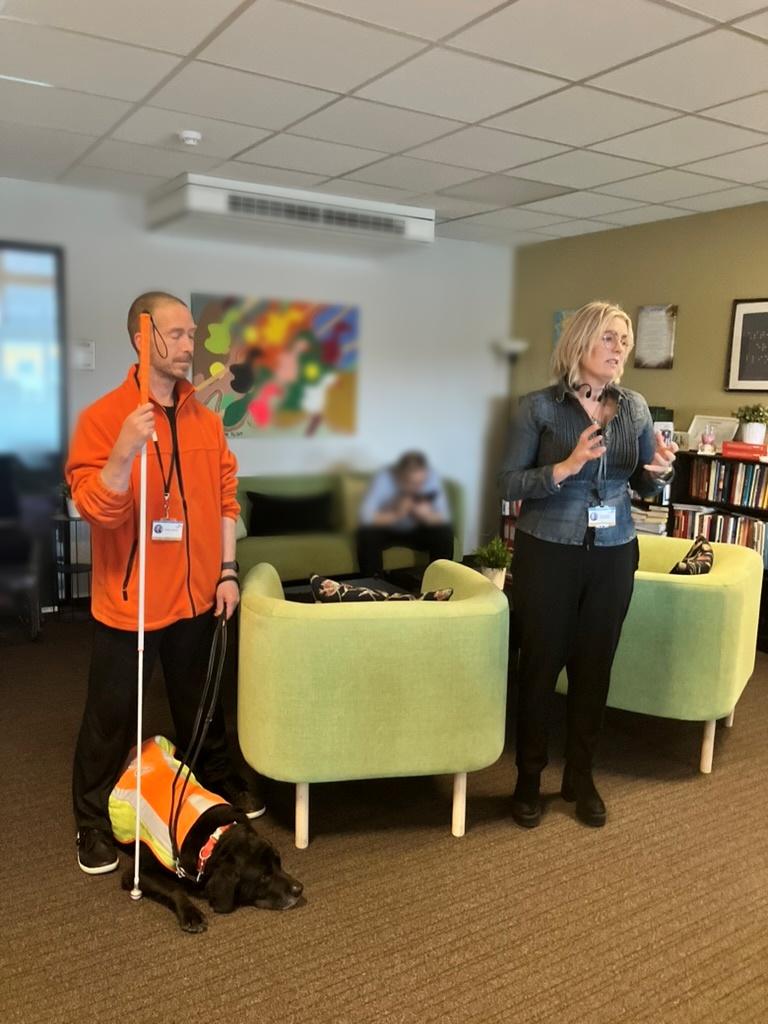
Director, Elfa Svanhildur Hermannsdóttir, and Assistive Technology Advisor, and Þorkell Steindal (with his dog “Dude” at the Blind Institute)
The visit highlighted Iceland's strong commitment to innovation. Staff demonstrated ongoing projects involving accessible wayfinding systems, AI-supported production of accessible materials, tactile maps produced through 3D printing, specialised assistive technologies and the development of Icelandic-language accessibility solutions. Discussions also covered the growing role of artificial intelligence in creating accessible educational materials and audiobooks more efficiently.
The delegation toured the Institute's modern facilities, which bring together rehabilitation, training, family support, technology instruction and accessible production services in a single location. This integrated approach facilitates cooperation between specialists while providing users with a comprehensive support environment.
Conclusion
The visit demonstrated a strong and constructive partnership between disability organisations, government authorities and service providers in Iceland. A spirit of cooperation, rather than competition, was repeatedly highlighted as a key factor behind progress in accessibility and rehabilitation services.
Both the WAD conference and the institutional visits illustrated Iceland's determination to advance accessibility, independence and social inclusion for blind and partially sighted people. Although challenges remain, particularly in relation to funding, technology deployment and growing service demand, Iceland offers several examples of good practice in user-centred service delivery, accessibility governance and innovative use of technology.
For EBU, the visit provided valuable opportunities to strengthen cooperation with Icelandic partners, exchange expertise and identify areas for future collaboration in all fields of actions at European level, including advocacy, accessibility, assistive technology, and digital inclusion.