

Horizontal
We continued to use the concluding observations of the UN CRPD Committee after its review of the EU, to lobby the European Parliament Rapporteur and Shadow Rapporteurs on the report on the second part of the Disability Strategy 2021-2030.
We met with the Equality Commissioner, Hadja Lahbib on 6 June. This was an opportunity to present EBU, its vision, its mission, and our main achievements. We called for an ambitious phase two of the EU Disability Strategy, building on the recommendations of UN CRPD Committee, focusing on those issues of core interest to us. See our press release about this meeting.
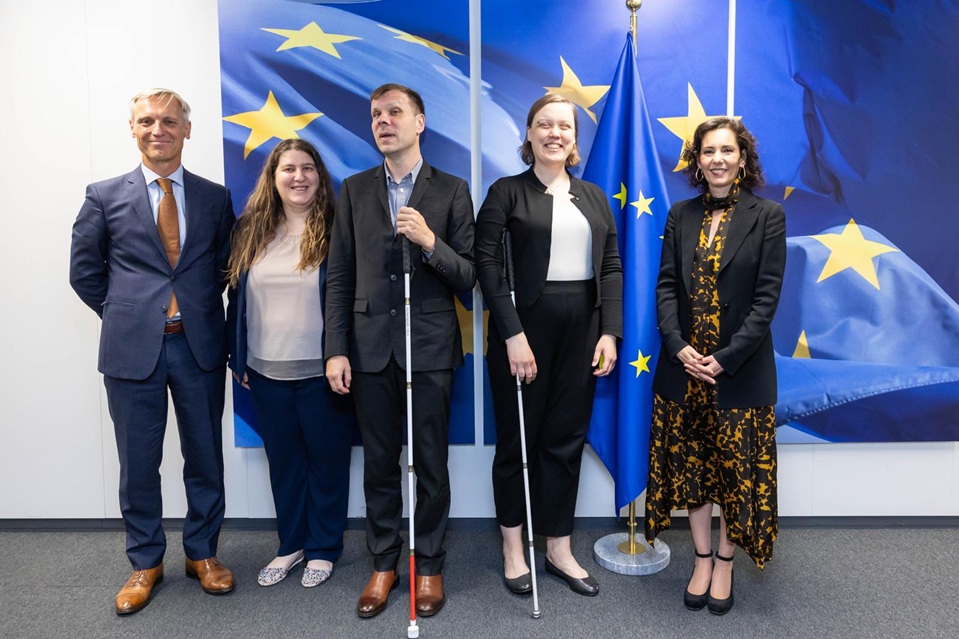
The EBU delegation, from left to right ; Antoine Fobe, Francesca Sbianchi, Lars Bosselmann, Tytti Matsinen and on the right Hadja Lahbib, Commissioner for Equality and Crisis Management.
We attended the EU Disability Platform plenary, where the incoming Danish Presidency presented its priorities. Regarding disability, specific attention will be paid, inter alia, to: independent living, with a conference of 6-7 November in Copenhagen in collaboration with EDF leading to EU Council conclusions; social services; and elderly care (a high-level conference on 27-28 October). There was discussion around the recommendations to the EU by the UN CRPD Committee. See below, about the Marrakesh Treaty. The European Commission confirmed that civil society organisations will be consulted on the second phase of the EU Disability Strategy and that the UN CRPD recommendations will inspire it, but there is still no clear timeline for this. The EU humanitarian office (ECHO) will also consult, on the EU Preparedness Strategy. We asked to be part of this consultation, to bring the point of view of visually impaired people for assistance to persons with disabilities in emergencies and natural disasters.
We have started to prepare the annual Advocacy Committee meeting, which is planned to take place in Vilnius, Lithuania, on 18-19 October.
Employment
We participated in the meeting of EU Disability Platform's Employment Subgroup, to discuss dissemination of the Employment Package. Also addressed were other issues not covered. The Commission’s DG EMPL pointed at transition from education to employment, work-ability assessment, and the compatibility of disability benefits with employment as issues it wants to address, as well as the potential of AI for the employment of persons with disabilities. EBU informed the participants about its ongoing work on a background note for the European Semester on the compatibility of disability benefits with employment, for which we have started to get input from our members in the EU. Regarding work-ability assessment, we intervened to make a parallel with the European Disability Card and promote a solution in transition to ensure free movement of workers with disabilities. Regarding AI, we suggested that it could be used to match available suitable jobs with job-seekers with determined disabilities.
At the Consultation Strategic Dialogue meeting on the review of European Pillar of Social Rights Action Plan, we intervened to flag the Disability Rights Strategy as a key achievement, specifically the Employment Package, and the good dynamic brought by the connection with the Disability Platform and the Strategy’s Monitoring Framework. We deplored however an insufficient participation of Member States in the Platform. Regarding areas insufficiently addressed, we pointed at: remedying the disability employment gap effectively, namely through transition from education to employment and through stopping the disability benefits trap; disaggregating data by type of disability; and ensuring the free movement of workers with disability through at least a transitional solution to having to get one's work-ability status recognised.
Inclusive design
In response to the public consultation on the Consumer Agenda 2025-2030 and action plan on consumers in the Single Market, we stressed accessibility of products and services and the gaps of the European Accessibility Act, as regards household appliances and labelling of food products in particular.
In follow-up to our meeting with the Equality Commissioner, we sent a note to her cabinet member for disability, to elaborate on our EU Marrakesh Treaty Directive issue, with copy to the Disability Unit of DG JUST, so that they take up the issue with DG CONNECT (leading on the review of the Directive). At the Disability Platform Plenary, about the CRPD’s concluding observations, we focused on the need to drop, in the EU Marrakesh Treaty Directive, the possibility for Member States to have a compensation scheme (Denmark being one of the 6 countries using this possibility). The Commission showed support for the EBU message and even encouraged us to expand on the complementarity of the Marrakesh Treaty with the European Accessibility Act – possibly an outcome of our meeting with Commissioner Lahbib.
28 June was the deadline for the accessibility requirements for a range of products and services to become a reality under the European Accessibility Act. We issued a statement about it. In the statement, we call on businesses to “get their act together” to comply with the new obligations. We also engage EU Member States to go beyond minimalist implementation and look at areas not covered by the EAA, including household appliances for instance.
Road safety
Our German member DBSV, in partnership with NSB and on behalf of WBU, continued the lobbying of UNECE's subgroup on quiet road transport vehicles (QRTV), reporting to the Working Party on Noise and Tyres (GRBP) and working on a revision of UN Regulation No. 138 (a global instrument dealing with the sound requirements for electric and hybrid electric vehicles, that specifically mandates the use of an AVAS). The aim is that EU, especially Germany, promote rules at least as strong as those existing in the EU.
Miscellaneous
We responded to a public consultation on European statistics – multiannual rolling planning for 2029-2036 (delegated act) to stress our demands in our statement of January 2024 regarding persistent limitations of Eurostat data on disability.
Response to public consultation on EU Civil Society Strategy, to express concern about moves by some groups in the European Parliament to question the financing by the EU of civil society organisations active in EU advocacy (focusing on environmental NGOs for now).
The Polish Presidency of the EU drafted a Declaration of the EU Member States on Raising Awareness of Persons with Disabilities, and has invited EU Member States to join. The idea is to ensure their visibility as 'ordinary' citizens in mainstream media. Invitation to MS to join.
In an EPSCO meeting of the Council, the Polish Presidency (ending) and the Danish Presidency (incoming), backed by a vast majority of Member States, very strongly supported efforts to adopt the proposed Equal Treatment Directive and called on the Commission to reconsider withdrawing its proposal which would be “a very bad signal to citizens after 18 years of work on this”. Sadly, Germany, Italy and Czechia continue to block the proposal, making it unlikely that the Commission maintain its proposal.
We attended an EDF-ENGO meeting around the EU long-term budget and funding for European NGOs, updates on Passengers Rights and EDF Human Rights Report, EDF work on Climate Action, and the state of persons with disabilities in Ukraine.